
Our location - complete with lantern-lit walkways covered with rose petals

All the masks were on before the dancing began

The dads kept theirs on the longest

Cooling off outside
It was a blast!!!


The best thing about reading aloud to children aside from developmental progress and all that good stuff, is onomatopoeia. “Clang, clang!” “Harrumph!” “Chugga-chugga” “Choo-Choo” “Splat” “Ring! Ring!” “Flutter, Flutter.” Wonderful children’s literature doesn’t just progress along the pages in staid font transferring information, it sings out from the very book at us! Be it Mike Mulligan’s steam shovel digging away furiously or Peter Rabbit hopping lippity, lippity through Mr. MacGregor’s dangerous garden patch, we are fully engaged from once-upon-a-time to everyone-lived-happily-ever-after. Ducks wear poke bonnets, trains wish desperately to make children happy, dreams come true, elephants and carpets fly, and small children affect the outcome of their worlds. Adults who wear business attire and behave perfectly appropriately in steel and glass towers day after monotonous day transform themselves into snakes, mean old hags, princesses with snooty accents, and sorrowful baby bears when a small child is snuggled on their lap with a good book. Is it any wonder that a happy child’s evening litany includes “Read one more book, please?”


"Writing is easy. All you do is stare at a blank sheet of paper until drops of blood form on your forehead."
Gene Fowler


Phillip Johnson was born and raised in Aurora, Illinois and graduated from Harvard and the University of Chicago Law Scchool.
After law school, Phillip Johnson clerked for Chief Justice Roger Traynor of the California Supreme Court and Chief Justice Earl Warren of the U.S. Supreme Court. He joined the faculty of the Boalt School of Law at the University of California at Berkeley in 1967 and has been a Professor Emeritus since 2000.
Johnson has served as deputy district attorney while on leave from his teaching duties and has held visiting professorships at Emory University and at University College, London.
With the publication of his book "Darwin on Trial" in 1991 he began a second career as one of the foremeost critics of Darwin's Theory of Evolution and its wider sociological and cultural implications.
Johnson is one of the leading members of the Intelligent Design movement and has done much to help these ideas gain acceptance and a wider hearing worldwide.
Johnson is the author of several books on evolution, philosophical naturalism, and other cultural issues and speaks extensively around the country. His "Leading Edge" column appears regularly in Touchstone Magazine.


Iam from peddle-pushers and freckle-face strawberry,
from Folger’s Instant and Kodak Instamatics.
I am from iris on the walkway, pyracantha for the birds to feast on,
from towering pines for hide n’ seek,
from chalk and hopscotch and roller skates and four square.
I am from hardwood floors calling, “Mom’s home!”,
from the sizzling cast iron with pancakes in animal shapes,
from the gas stove going “poof” if you took too long.
I am from the smell of fresh-mown grass and burying yourself in the piles,
from wave chases and sandy PBJs at Natural Bridges,
from olive trees wreaking havoc on the back patio and squirrels chirping
while cats stalk back and forth in front of the picture window.
From daffodils in the sandbox every spring.
I am from rare letters, perfect penmanship,
loud snoring and rollicking laughter,
From TWC and Joe and women I did not know,
paths traced from Ireland and Huguenots,
from simple folk and rich relations.
I am from only-the-good-news, weak lungs and prejudice.
From inner-family squabbles and fierce family loyalty.
I am from “that’s just the way that it’s done” and “say ‘g’ as in Gault”,
from sitting up straight at the table and “run along and play.”
I am from “It Only Takes a Spark”
and I believe in One God the Father Almighty,
from kneelers and stained glass windows.
I am from the down-the-road youth group where my heart was filled.
From campfire songs and Easter-week service projects.
I am from Fort Collins and Montreal,
Iowa City and Rye, New York.
From turkey dinners and tuna casserole,
from steak and Yorkshire pudding.
From holidays with Mom and weekends with Dad.
I am from two different worlds.
From risk-taking men and women who went along,
from Wall Street and the Malibu hills,
from golf course vacations.
I am from Charlotte’s Web and Puff having kittens
while men landed on the moon.
From quiet walks in the rain and fudge during Wizard of Oz.
I am from Gramps guarding the Christmas tree.
I am from the box of memories deep in Mom’s closet,
from the empty baby book and the stories told by someone else.
I am from best forgotten and moving forward.
I am from surviving and forgiveness,
from simple pleasures,
from making the best of it.
I am from stubborn determination and new life, from the miracle of joy and stability.
"In conversations I have had with numerous college admissions officers, I have not encountered any whose college has a policy of refusing admission to students who have been homeschooled. Although concerns and cynicism exist at some colleges, most colleges express interest in receiving applications from homeschooled students. Colleges that have accepted homeschooled students appreciate the maturity and self-direction these students demonstrate. They believe that because homeschooled students have been involved in shaping their own education, they tend to be motivated learners and are comfortable assuming positions of leadership, both in class and in social situations."
"Homeschooled students, who will apply to college without a standard high school transcript and honor society membership, need to be proactive as they anticipate the college application process. As parents plan their child’s high school years, they would do well to think about the type of college their child might attend — public/private, selective/non-competitive, large research university/small liberal arts college. As they record their child’s progress, they should be aware of ways in which many colleges are likely to evaluate their child’s readiness for college work."



Life itself is like a first draft. One of the sources of the global sense of inadequacy that's bedeviled me all my life is my belief that I should be able to do everything right the first time.
None of us is James Bond, sauntering through our adventures in the best clothes, never putting a foot wrong and always knowing what wine to order. In fact, even the guys who play James Bond aren’t James Bond. They sometimes stumble when they step off the curb (especially after ordering that wine), and they sometimes spill salad dressing on their shirt fronts, and they sometimes say things they didn’t mean to say and wish to heaven they could take back. James Bond doesn’t do those things, because if he does the director just yells “Cut!” and they re-shoot the scene. But you and I don’t have directors or re-shoots. We’re Reality TV, and our mistakes go on our permanent records.
But we’re all in the same boat. Much as I might believe it, there are no James Bonds out there having their lives simultaneously edited for them. The doctrine of salvation by grace, not works, is grounded in the fact that God Himself recognizes, and has pity for, this fact.




"Early on in Sunday school or catechism class, we learned the Golden Rule: "Always treat others as you would like them to treat you." Yet our melancholy marriages, dysfunctional families, splintered churches, and loveless neighborhoods indicate that we have not learned well.
'Learning by heart' is another matter entirely. The rhythm of relentless tenderness in the Rabbi's heart makes loving terribly personal, terribly immediate, and terribly urgent."


"Those who wish to glimpse what the future holds or even to know present culture in its purest form very often look to the mental and moral health of the nation’s youth. And what they find is generally discouraging. The over-sexed, underdressed teenagers who seem to alternate between hanging out at the mall and spilling out the intimate details of their lives on myspace.com do not seem to be preparing themselves for positions of moral and political responsibility. Even at the other end of the spectrum, at the nation’s leading universities, young people seem to lack strong character."
"Flat-souled youth. Organization kids. Charlotte Simmons. As accurate as these portraits of America’s contemporary youth culture may be, I have become increasingly convinced that they are local accounts, based on observations of students at the University of Chicago or Princeton or Stanford or some other elite institution, that tell only one story—and perhaps not the story that gives the greatest insight into the future, or of one possible future, of America. There may, in fact, be another story with a far happier ending."
This excess of informality is very undignified and unattractive and results in a society constantly on edge, even in the smallest of interactions. I think it explains in part the worldwide success of a series of books by my friend Alexander McCall Smith about a lady private detective in Botswana called Mma Ramotswe. For the African society that McCall Smith portrays so eloquently in these books is one in which a certain formality and ceremoniousness of manners still exists, which come as a great and instant relief to people who live in societies that are altogether without them. Not only do the ceremoniousness and formality help to smooth the rough edges of social interaction, but they allow some grading of such interaction, according to degrees of desired or achieved intimacy. Formality, moreover, is the precondition of subtlety and even of irony; without formality, life becomes coarse-grained and crude. The distinction between friendliness and friendship becomes blurred so that it is no longer even perceived.


"The evangelical tradition holds at its best the belief that faithful Christian witness involves caring deeply about one’s neighbor—and hence about truth, justice, and love extending beyond the bounds of the meeting house. So, too, the evangelical tradition holds a recognition of God’s sovereignty and providential ordering in the affairs of men and nations, which is an antidote to both despair and utopianism.
Will evangelicalism survive its success? This question is seriously debated by serious scholars and the answer has proved elusive. Some see evangelicalism as a fiction, a grand public-relations ploy held together by powerful personalities for several decades but that has now run out of steam. Others claim this is the 'Evangelical Moment.' Still others call for revisioning, repositioning, and recentering evangelicalism.
But 'center' is the wrong image, I think. Especially when center is defined as the middle point on a spectrum, denoting a middle ground between radicals and liberals on the left and reactionaries and conservatives on the right. I want to suggest another image: core, from the Latin word for heart. 'Evangelical ecumenism' may be an oxymoron, and its theme song might be the country music classic by George Strait, 'Let’s Fall to Pieces Together.' But I suggest that ecumenism is a central portion—a core concern—of the evangelical faith and the evangelical church."
Randi has issued the Get Real Monday Challenge again, this time asking what we do to relax and re-energize. Well, let me count the ways. I love to read, I love to take a power nap, I love to be outside with my children. Working in the garden or cleaning house can even be relaxing, if it's not a rush job. If, however, what I need is to be alone for a bit, I usually find a place at home rather than going out. Going out gets expensive, and that does not relax me.
The bath is always a good choice, here shown with candles (especially helpful if your bathroom is not spotless.) This was my choice for Saturday night, and I listened to a CD from the CiRCE institute. No book to drop in the water, no need to keep my hands dry. Very relaxing bath, very re-energizing CD.
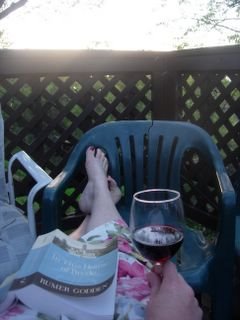
My other favorite spot is the deck on a warmish evening. I am usually joined by a cat or a dog, but they don't ask much; a pat every now and then, and their companionship is worth it. I often hear the work or play of a child or two or three outside, or the sounds of the piano floating out the window. This corner of my deck is the theater for sunset viewing, and it was the perfect place for reading In This House of Brede.



COVID:2 Collage Four years ago today we all came home for the lock down. Middle school classes conducted by zoom on the deck, college cours...


