
Staff photographer at work

Cooling off quickly

The woods

Chilly bird house

Watching the snowfall

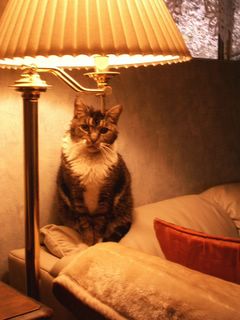
Warming up inside
"ALL’S WELL that ends well. And if all doesn’t end well, it should be forced to. This is the conclusion of a new survey for World Book Day, which found that most readers would far rather read a novel that ends happily ever after. Pride and Prejudice was voted the happiest ending in literature, followed by To Kill a Mockingbird and Jane Eyre.
Only one in fifty readers, it seems, likes to be left tearful at the last page, so the survey also asked which unhappy endings readers would most like to change: Tess of the D’Urbervilles was a clear winner, with readers demanding clemency more than a century after Thomas Hardy sent his tragic heroine to her death. It was also felt that the endings of Wuthering Heights, 1984 and Gone with the Wind were all too depressing, and should be perked up."
"No writer worth the name sets out to produce happy or unhappy endings, let alone seeks to alter existing literature to produce one or the other. It is not the mere happiness or unhappiness of fiction that grips us, but the questions it asks, the people and situations it creates, the complexity of emotions it stirs. Some of the greatest endings in literature are neither uplifting nor distressing, but inquiring."

"The phrase “Fair Trade coffee” has percolated into the vernacular, and the label it represents pervades the business at every level."
"Katzeff—compassionate, articulate, and only slightly megalomaniacal—may have been most effective as a salesman pitching righteousness rather than a crusader fighting Central American poverty. The hippie spilling buckets of fake blood may never break bread (or sip coffee) with straight-laced businessmen talking quality, but the consumer has little to lose from a synthesis of strong words and strong lattes. Another Starbucks, a better coffee, a calmer conscience: What caffeine fiend can argue?
“I was a sparkplug,” says Katzeff. “I changed an entire industry.” He’s talking about a revolution in coffee farming, but the transformation he inspired may be more lasting in the minds of coffee consumers in the First World than in the lives of producers in the Third."


"But our favorite Michelangelo project was when I taped butcher paper under the dining room table, spread newspapers across the floor, and let them "paint the Sistine chapel ceiling."
Yes, they got paint in their hair and all over their clothes, but children wash."
"Lent (literally "springtime"” ) is a time of preparation, a time to return to the desert where Jesus spent forty trying days readying for His ministry. He allowed himself to be tested, and if we are serious about following Him, we will do the same.
First popularized in the fourth century, Lent is traditionally associated with penitence, fasting, alms giving, and prayer. It is a time for "giving things up"” balanced by "giving to"” those in need. Yet whatever else it may be, Lent should never be morose - an annual ordeal during which we begrudgingly forgo a handful of pleasures. Instead, we ought to approach Lent as an opportunity, not a requirement. After all, it is meant to be the church's springtime, a time when, out of the darkness of sin's winter, a repentant, empowered people emerges. No wonder one liturgy refers to it as "“this joyful season."
Put another way, Lent is the season in which we ought to be surprised by joy. Our self-sacrifices serve no purpose unless, by laying aside this or that desire, we are able to focus on our heart's deepest longing: unity with Christ. In Him - in His suffering and death, His resurrection and triumph - we find our truest joy."
Faithful God, trusting in you,
we begin
the forty days of conversion and penance.
Give us the strength for Christian discipline,
that we may renounce evil
and be decisive in doing good.
We ask this through Jesus Christ.
Almighty God, you have created us out of the dust of the earth: Grant that these ashes may be to us a sign of our mortality and penitence, that we may remember that it is only by your gracious gift that we are given everlasting life; through Jesus Christ our Savior. Amen.
"If imitation is the sincerest form of flattery, what is plagiarism? The least sincere form? A genuine crime? Or merely the work of someone with less-than-complete mastery of quotation marks who is in too great a hurry to come up with words and ideas of his own?"
"In the realm of plagiarism, my view is, better a lender than a borrower be. (You can quote me on that.)"
In the spirit of encouraging each other and having a good laugh, post a picture of your "real life", your "real house" or your "real self" on Monday, February 27 and add one surprising fact about yourself.


I write to inspire myself. I take note of beautiful, good, true things so that I won't forget them...not because my life is made up of only beautiful, good, true things.
I suspect that's true of most bloggers when it comes down to it.
When people come to my house to visit, it is my goal to make them feel so warm and welcome that they will not notice the ugly light fixtures or freaky seventies decor. This is a struggle for me too because I am an introvert - small talk and light conversation don't come easy to me. But I pray for them before they come, light the candles, play good music, and make them something comforting to eat. I hope they feel completely at ease.
I want you to feel the same when you visit me at Intent. We are just simple, ordinary people here; pull up a chair, put your feet up and be yourself. There are brownies in the oven...
Wodehouse never wrote about India, but sells better on the subcontinent than in Britain, with pirated copies in common circulation. He is one of the most heavily requested authors at the British Library in Delhi and there are clubs and internet chatrooms devoted to him.

The religious foundation for religious liberty, therefore, begins with the nature of God. It also sketches out its conviction about the nature of human beings: that we are born free and equal to all others in freedom before God, and that, independent of the state, each of us owes duties to our Creator. Based on these convictions, the religious justification of religious liberty as expressed by the Virginians is founded on the natural right of human beings, as these have been endowed in human beings by their Creator.
So thorough and profound are these rights, moreover, they are not limited to Jews or Christians, but possessed by all human creatures - Muslims, Hindus, and Buddhists alike, together with atheists and agnostics. For all are given their liberty directly by the Creator, in the act of creating human beings. From before time was, the Creator knew each individual by name and called all to Himself - but allowed to all the right to accept or to reject that invitation, according to their own conscience.
It is the rare reader of fiction who does not at some time or other consider becoming a writer. It comes and goes over the years for many, and some carry it about forever as an unredeemed promissory note to themselves. In their heart of hearts, they regard themselves as writers. When my first novel appeared, I got a note from a senior colleague to the effect that it was sly of me not only to think of writing a novel but actually to do it. The capacity, apparently, like depravity for Calvin, was taken to be universal.


If the Pharisees had known what it meant to love the Lord with "all your mind" (Mark 12:30) and not to reduce righteousness to rote rules, they might have understood why mercy is better than sacrifice (Matthew 12:7), and why money donated to the Temple does not absolve you of obligation to your parents (Matthew 15:1-9), and why people hanging around Jesus don't feel like fasting (Mark 2:18-22).
I have often wished the Christian life were a to-do list dispensed daily from on high, eliminating guesswork:
* Today, call your mother
* Increase your tithe by $20
* Send Calvin to Philmont Christian Academy
* Read this book, not that one
* Move to Winnsboro, Texas
* Plastics!
I would gladly comply with that kind of piety. But I think the Christian life is by faith in order that it be by engagement of "all your mind" (Romans 14:5b).
Today fewer than 10% of Americans live in households of five or more people and only 1.8% in families of seven or more. That means that if your family consists of a mother and father and five children, you live where I do, which is statistically on the lunatic fringe.
There is, however, one corner of the U.S. where family size has suddenly expanded to titanic proportions, and it isn't Utah. It's Hollywood.
"On film, vast numbers of ankle-biters inevitably means enduring a dreadful mess. Fully laden buffet tables collapse, porridge flies, pitchers of orange juice spray across the room. These are all visual metaphors for the loss of control and decorum that having a large number of children apparently entails."
"People always tense up when they see a big family coming," observes our 11-year-old, a veteran observer of adult fastidiousness. "Movies like these are cute," she says, "but they don't do anything to lessen the idea that if you have a large family, something is going to explode" (a common occurrence in these movies.)
No longer the bailiwick of religious fundamentalists or neo-hippies looking to go off the cultural grid, homeschooling is a growing trend among the educated elite. More parents believe that even the best-endowed schools are in an Old Economy death grip in which kids are learning passively when they should be learning actively, especially if they want an edge in the global knowledge economy. "A lot of families are looking at what's happening in public or private school and saying, 'You know what? I could do better, and I'd like to be a bigger part of my kid's life,"' says University of Illinois education professor Christopher Lubienski.
"Love is an exploding cigar we willingly smoke." Lynda Barry
With malice toward none, with charity for all, with firmness in the right as God gives us to see the right, let us strive on to finish the work we are in, to bind up the nation's wounds, to care for him who shall have borne the battle and for his widow and his orphan, to do all which may achieve and cherish a just and lasting peace among ourselves and with all nations.(With thanks to Semicolon for the link.)


"I never expected to be an author! But I do think there are some amusing things about the story of Andrew and myself and how books broke up our placid life. When John Gutenberg, whose real name (so the Professor says) was John Gooseflesh, borrowed that money to set up his printing press he launched a lot of troubles on the world.
Andrew and I were wonderfully happy on the farm until he became an author. If I could have foreseen all the bother his writings were to cause us, I would certainly have burnt the first manuscript in the kitchen stove."







"After studying 25,000 children across both state and private schools, Philip Adey, a professor of education at King's College London confidently declares: 'The intelligence of 11-year-olds has fallen by three years' worth in the past two decades.'"
"In their painstaking research project Adey and his colleague, psychology professor Michael Shayer, compared the results of today's children with those of children who took exactly the same test in the mid-1990s and also 30 years ago. While most exams have changed (been made easier, if you listen to the critics) this one is the same as it was in 1976 when pupils first chewed their pencils over the problems." (London Times)
"...the question that must be answered is why children's developmental skills have fallen off so much. Shayer is reluctant to be drawn into specifics.
'We can speculate,' he says, 'but there's no hard evidence. I would suggest that the most likely reasons are the lack of experiential play in primary schools, and the growth of a video-game, TV culture. Both take away the kind of hands-on play that allows kids to experience how the world works in practice and to make informed judgments about abstract concepts.'" (Guardian)
"Don't put those winter coats away just yet. The world's most famous weather prognosticating groundhog was roused from his burrow at 7:23 a.m. Thursday and saw his shadow, a sign that there'll be six more weeks of winter."

COVID:2 Collage Four years ago today we all came home for the lock down. Middle school classes conducted by zoom on the deck, college cours...


